

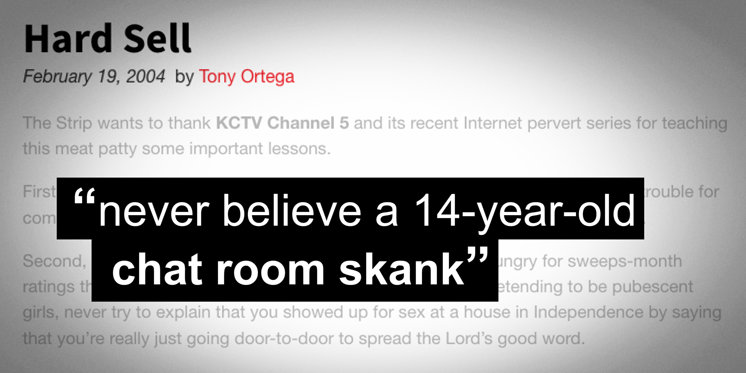
Twenty-two years ago today, on February 19, 2004, Ortega published a column that openly mocked televised investigations into adults seeking sex with minors online.
Writing under the headline “Hard Sell,” Ortega framed the exposure of would-be child sex abusers as wrongful, hysterical, ratings-driven theater, and shockingly cast law enforcement stings and civilian watchdog efforts as the true objects of scorn, rather than the men attempting to sexually exploit children.
By casting investigators as the real wrongdoers while minimizing adult sexual predation, Ortega perfected the approach he would later use defending Backpage.
Ortega sneered that a pedophile should “never believe a 14-year-old chat room skank”—a reference to KCTV Channel 5’s undercover sting in which adults posed as minors to identify and expose sexual predators. He had no such objection to the men who procured children for sex. Instead, he said that Channel 5, the local CBS affiliate, “has now established beyond a doubt that if your 14-year-old is hankering for oral sex and a six-pack of beer from a flabby geriatric, satisfaction is just a few keystrokes away.” In doing so, Ortega blamed the victims of child sexual abuse for the crimes committed against them—and still does to this day.
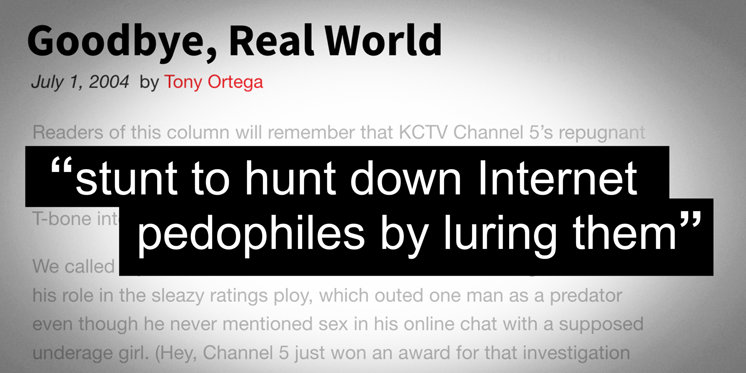
Five months later, still apparently fixated on what he deemed an injustice against those “flabby geriatrics,” Ortega condemned the same investigation in even more explicit terms, referring to it as “KCTV Channel 5’s repugnant February sweeps-month stunt to hunt down Internet pedophiles by luring them.”
At the core of “Hard Sell” was Ortega’s attack on Perverted-Justice.com, a civilian group that archived chat logs and assisted media and law enforcement in identifying adults attempting to solicit minors. Rather than grapple with the substance of those transcripts, Ortega mocked the volunteers who compiled them. He suggested they enjoyed the work too much—implying a moral equivalence between investigators who put predators in prison, over and over, and sexual predators—lingering not on adult culpability but on the nonexistent impropriety of those working to protect children.
Replete with slurs directed at minors, sarcastic “lessons” aimed at adult men caught in stings, and sneering asides about investigators, Ortega’s language was not incidental seasoning. It was the substance. Ortega presented concern about online child predation as a moral panic. He ridiculed the premise that the internet posed a serious risk to children. And he redirected suspicion toward those gathering evidence against predators. “Hard Sell” thus stands as an early and definitive manifestation of Ortega’s professional pattern, one that would later reappear at far greater scale: the sustained public defense of platforms and narratives that downplayed or denied child sexual exploitation, treating the exposure of sexual crimes as the real offense.
By casting investigators as the real wrongdoers while minimizing adult sexual predation, Ortega perfected the approach he would later use defending Backpage, the classified advertising site that became synonymous with the industrialized sexual trafficking of children.
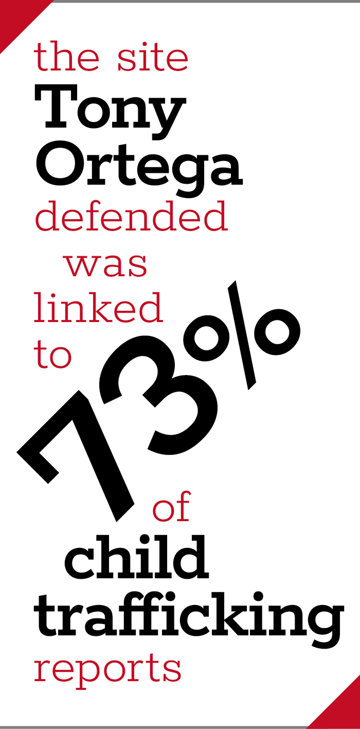
According to a US Senate staff report, the site was involved in 73 percent of all child trafficking reports received by the National Center for Missing and Exploited Children. Federal prosecutors described it as knowingly facilitating prostitution and laundering proceeds derived from sexual exploitation. These findings, which prompted the FBI to shut down Backpage in 2018, were established through extensive investigation, seized internal documents and criminal proceedings.
And yet, as a prized employee of its parent organization, Ortega publicly and repeatedly championed Backpage, attacking anti-trafficking advocates and characterizing scrutiny of the site as an assault on free speech. He wasn’t just employed by the parent company of Backpage—he had a vital function with regard to the site: operating as its public-facing defender and enforcer. Ortega serially and systematically deployed his platform at Village Voice Media to discredit critics, blunt scrutiny and aggressively target journalists and activists documenting Backpage’s role in exploitation.
As part of his sustained defense, Ortega characterized sex trafficking as “a mass panic,” a “national fantasy,” and a “small problem,” and targeted those exposing what he called a “nonexistent epidemic of sexual slavery.” In one column, he pronounced that underage prostitution “is nothing like what is being trumpeted,” dismissing the scope and severity of the same exploitation that investigators were actively documenting at the time.
It’s why The New York Times famously described Ortega as Backpage’s “attack dog.”
Jeffrey Epstein was probably proud.
Ortega’s 2004 column reads like a disturbing preview of his entire career supporting the sexual abuse of children.
The legal reckoning that followed Backpage’s collapse left no question as to the illegality and depravity of the enterprise. Founders Michael Lacey and Jim Larkin—whom Ortega boasted were “smart enough to start Backpage”—were criminally charged. Larkin committed suicide before trial, and Lacey was sentenced to prison. Senior executives Scott Spear and Jed Brunst received 10-year federal sentences in August 2024. And, that same year, the US Department of Justice finalized a $215 million victim compensation fund drawn from seized Backpage assets, reflecting the scale of harm inflicted on trafficked women and children.
Against that backdrop, Ortega’s 2004 column reads like a disturbing preview of his entire career supporting the sexual abuse of children. “Hard Sell” dismissed the premise that online sexual exploitation of minors warranted investigation; his later “work” dismissed the principle that a platform profiting from exploitation should face any consequences at all.
By contrast, in recent months, individuals and institutions have faced swift professional consequences for even tangential associations with a single convicted sex trafficker. Universities, charities, corporations and political figures have severed ties, resigned posts or lost funding amid scrutiny over proximity to Jeffrey Epstein alone.
The cultural message has been unmistakable: Facilitation, normalization or indifference comes with a cost.
Yet Ortega’s record presents a striking counterexample: Despite a documented history of ridiculing accountability for sexual predators, defending the largest online sex trafficking marketplace in US history and attacking those advocating for victims, he continues to operate with financial and moral support from within institutions that publicly champion human rights. As previously reported by Freedom, that support has included sustained backing from his wife, Arielle Silverstein, a United Nations attorney whose salary continues to underwrite an unemployed Ortega.
Anniversaries are often exercises in nostalgia. This one is not. Twenty-two years after Ortega’s public defense of pedophiles, his column remains relevant because the damage it normalized proved scalable. What began as ridicule in an alt-weekly became advocacy with national consequence when applied to a platform that generated millions from the exploitation of innocent kids.
Ultimately, the lesson of “Hard Sell” is a reminder that contempt for investigations into sexual abuse is a position with reckonings—and history has already rendered its verdict on where such contempt leads.
Ortega’s own record, however, stands intact and largely unexamined. The question is no longer what he wrote in 2004. It is whether that record—and all that followed—will finally be weighed by the same standards now applied to everyone else.