

But in Germany, it could also cost you a job.
That is, until January 29, 2026, when the German Federal Labor Court affirmed a ruling in favor of a Muslim woman who had been denied employment for wearing a hijab.
The case began in 2023, when the woman applied for a job in security—checking passengers and baggage at Hamburg Airport. Her application included the required photo, in which she wore her hijab. The security firm declined her application, with no reason given.
The ruling is a victory for religious freedom in Germany, a nation still grappling with Islamophobia.
Suspecting the rejection was tied to her religious garb, she challenged the decision in court under Germany’s General Equal Treatment Act, which prohibits employment discrimination on the basis of protected characteristics, religion among them.
The company denied wrongdoing, asserting that gaps in her résumé—not her headscarf—led to the rejection, without specifying what those gaps were. They also claimed their internal policy prohibited head coverings.
Finally, they theorized, an airline security officer wearing a hijab might cause conflict among passengers already burdened by the security process—removing shoes, passing through a metal detector and placing carry-ons on a conveyor belt. The company could, however, produce no concrete evidence that a security officer wearing a headscarf had ever caused “conflict” in an airport check-in line.
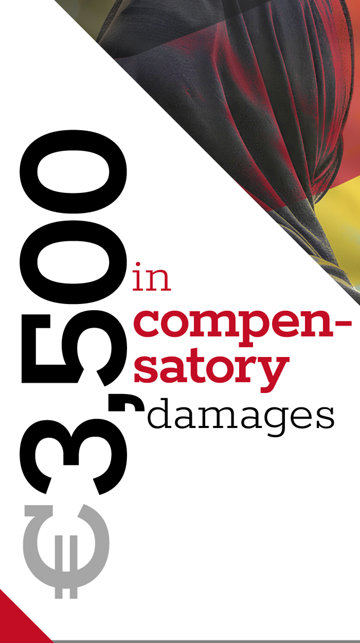
Neither the Hamburg Labor Court nor the higher Federal Labor Court was impressed. Both found in favor of the woman and awarded her €3,500 in compensatory damages.
The ruling is a victory for religious freedom in Germany, a nation still grappling with Islamophobia. In a recent annual report, the United States Commission on International Religious Freedom (USCIRF) cited the country for persistent anti-Muslim discrimination. Among the examples noted:
- Seven football fans assaulted a Muslim father and mother pushing a baby carriage.
- Several mosques received anonymous letters containing threats, insults, burned Quran pages, excrement and pork.
- A 14-year-old girl wearing a hijab was attacked by a man who verbally abused her, then beat her so severely she had to receive medical treatment.
USCIRF reported that “women who wore a hijab continued to face employment discrimination and that discrimination was made easier by the customary practice of requiring photographs as part of job applications.”
The Hamburg court addressed that concern directly, ruling that such practices can amount to unlawful religious discrimination.
Henceforth, according to the decision now upheld in federal court:
- Hiring in Germany must be based on ability, not on appearance or prejudice.
- Rejecting an applicant for wearing a headscarf or any other religious attire constitutes religious discrimination.
- When an applicant presents evidence of discrimination, the burden of proof is placed on the employer to disprove it.
In a climate where a piece of fabric can invite suspicion, hostility or even violence, the court’s ruling affirms a simple but essential principle: A headscarf is not a threat.
It is an expression of faith.