

For the survivors of New Zealand’s Lake Alice Psychiatric Hospital Child and Adolescent Unit—who had their childhoods stolen through beatings, electroshock, chemical restraints, medical experimentation, rape and starvation—the figures range from $160,000 to $600,000 based on the severity of the torture endured.
A new government report by an independent arbiter outlines how redress was calculated for the 37 survivors who chose to have their claims assessed individually, rather than accept a blanket $150,000 payout.
“The Lake Alice story is now a part of New Zealand’s dark history of abuse of children in care.”
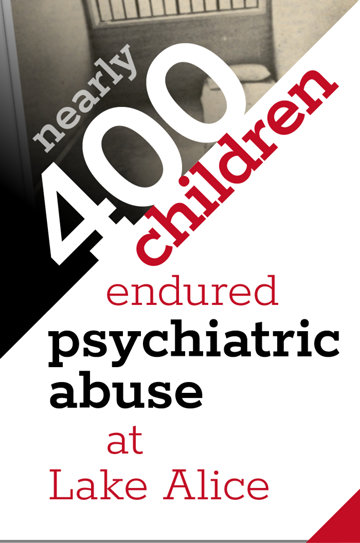
Lake Alice’s Child and Adolescent Unit was operational for only six years—from 1972 to 1978—but that proved to be plenty of time to inflict torture in the name of help on nearly 400 victims. They tell stories like these:
- “Mum and I went into Dr. Leeks’ office for about five minutes. He spoke to my mother, not to me. He then called a nurse in to take me upstairs and sent mum on her way. Upstairs I was told to strip out of my clothes and shower. I was then told to pick out some clothes from a big sack. I don’t recall ever being assessed by a doctor or nurse. It was not explained to me that I would be getting ECT. It was never explained to me what I was in for and I was never asked to consent to it.” —Malcolm Richards, Lake Alice survivor
- “That [solitary confinement] nearly killed me; my spirit, my soul, my wanting to live. I can’t even express what 21 days feels like alone in this world locked in that room knowing that I don’t have anybody on the inside or the outside that cares about me and that these adults can come and inject me and punish me, leave me a bucket to go to the toilet in, and leave me in this little box away from anyone. They were the longest days and nights of aloneness and complete abandonment.” —Leoni McInroe, Lake Alice survivor
- “I don’t remember a lot of what happened because of the drugs he would inject into me. The first time he did this, I woke up and he was standing at the end of my bed, my top had been pulled over my breasts and my jeans were down to the top of my thighs. He put me back to sleep again and when I woke for the second time, he was gone. I was sore and sticky between my legs. I felt drunk and ready to pass out. I knew that he had raped me.” —Sharyn Collis, Lake Alice survivor
Longtime patient advocate Victor Boyd—who has worked for decades as a volunteer researcher for Citizens Commission on Human Rights (CCHR), the mental health watchdog co-founded by the Church of Scientology and Dr. Thomas Szasz—described the facility’s “treatment” as nothing more than psychiatric experimentation on children. The Royal Commission of Inquiry into Abuse in Care found that many of the victims had no mental issues in the first place, even by psychiatry’s fraudulent standards, yet these well and healthy children were subjected to electroshock and painful sedative injections:
- “The injection would normally be put into the buttocks and the pain would go down my whole leg. It would be very hard to walk. The leg would feel dead and I would have no strength in it. It was painful to sit down for about three days. When I had it in my arm it would hang limp for the day. Once I was given it on the shoulder and on several occasions in the big muscle above my knees. This was a particularly painful place to have it and the staff were aware of this.” —Kevin Banks, Lake Alice survivor
In its final report—released July 2024—the Royal Commission confirmed that the abuses at Lake Alice constituted torture. That same month, the New Zealand government also formally acknowledged to the UN that the atrocities violated the Convention against Torture, an international human rights treaty designed to prevent such brutalities and hold governments accountable. In November of the same year, Prime Minister Christopher Luxon offered a public apology.
In announcing the redress arranged for psychiatry’s victims, senior government minister Erica Stanford praised the “courage, strength and resilience survivors have demonstrated throughout this process.”
In truth, it was the persistence of those survivors—supported for decades by CCHR—that finally forced the full horror of Lake Alice into public view.
Their work was formally recognized this past March when those survivors, alongside CCHR New Zealand, received the New Zealand Community of the Year Award. New Zealand CCHR Director Mike Ferriss, who helped spearhead the pursuit of justice on behalf of Lake Alice survivors, told Freedom that the award “goes a long way toward recognizing the decades of hard work it took as we celebrate truth overcoming adversity. There is now a heightened public awareness of abusive psychiatric treatment, and the Lake Alice story is now a part of New Zealand’s dark history of abuse of children in care.”
Then, on June 2, 2025, Victor Boyd received one of New Zealand’s highest civilian honors, the title of Member of the New Zealand Order of Merit, an honor he dedicated to survivors. Boyd’s decades of advocacy effectively put Lake Alice in the hot seat by documenting the abuse, pressing authorities for accountability and working with survivors to raise complaints with government agencies and the United Nations Committee against Torture.
Having spent decades pursuing justice and now in his 70s, Boyd is widely credited with forcing into the national conscience the anguish inflicted on the children of Lake Alice—an indelible stain on New Zealand’s history that he refused to let those in power bury or forget.
The six-figure redress announced in the government’s recent report does not even begin to make up for the lost childhoods of Lake Alice’s psychiatric victims. Stanford called it “an expression of our regret as to the many ways in which they were failed.”
But Stanford understands the emptiness of “an expression of regret.”
“We know no amount of money can ever undo or fully recognize the harm and abuse survivors were subjected to,” she said.