

The Daily Mail’s latest anti-Scientology hit piece reaches back more than half a century to regurgitate allegations about life aboard a ship that stopped serving the Church of Scientology in 1975.
Breaking News Alert: The Daily Mail is trash.
But the age of the false and discredited allegations isn’t the most remarkable thing about Eliana Silver’s August 9 article. What makes the story a case study in journalistic malpractice is what Silver knew before she published it—which is that she was writing a lie.
Silver’s primary source, Danielle Chamberlin, falsely alleged mistreatment aboard the Apollo, the former flagship of Scientology’s Sea Organization, in the 1970s.
Silver asked for the facts. The Church provided them. She published lies anyway.
Yet before publication, Silver was told that Chamberlin was kicked out of the Sea Organization for serial theft of Church and staff property—and that Chamberlin subsequently petitioned to return to the very religious order she now maligns.
Silver asked for the facts. The Church provided them. She published lies anyway.
The result was the 2,277-word article with a lurid “slave ship” headline in which the Mail gave the Church 112 words—or three sentences—to respond.
That ratio alone tells a story.
The documents tell an even better one.
Chamberlin joined the Sea Organization with her mother in 1973 and, with her mother’s permission, traveled to the Apollo. Within less than a year, she was caught repeatedly stealing and was removed from the religious order for misconduct.
This is not the Church’s version of events—it is Chamberlin’s own handwritten account.
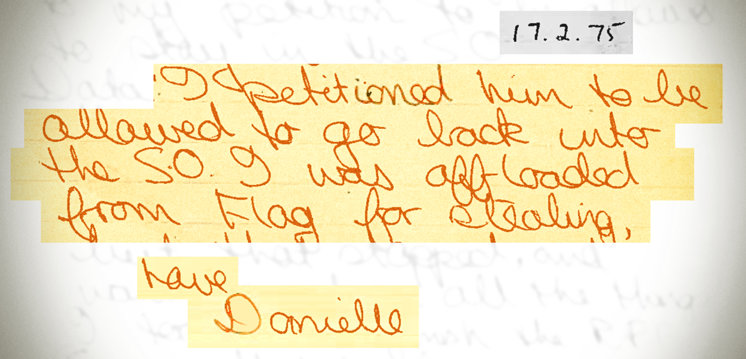
“I petitioned him to be allowed to go back into the S.O. [Sea Organization],” she wrote in 1975. “I was offloaded from Flag for stealing.”
That poses an obvious problem for a story attempting to depict Chamberlin as a victim. An actual journalist would have asked why Chamberlin was pleading to return to the very religious order she now claims mistreated her—and why her present-day account leaves out the inconvenient fact that she was kicked out for theft.
But Silver is not an actual journalist. She is just as bad as Chamberlin.
She had been warned repeatedly—both by phone and in writing—that Chamberlin’s own record contradicted the clickbait story she was selling.
Still, Silver tried to reassure the Church that she was approaching the story in good faith. The article “isn’t a sort of hit piece or anything,” she said. She further explained that Chamberlin’s statements would be presented as “allegations” and that the Church could provide evidence and a response.
Her assurances lasted only as long as they did not interfere with the hit piece she knew all along she would publish.
“I don’t reveal how I got in touch with these people.”
So when the time came, Silver used the tabloid to perform a familiar journalistic sleight of hand: Construct thousands of words around sensational allegations and relegate evidence fatally undermining the credibility of those allegations to a footnote.
Silver also collapsed half a century of history into a bigoted present-day attack.
Chamberlin’s central allegations concern events aboard the Apollo around 1973.
The Sea Organization permanently moved its flagship operations ashore to Clearwater, Florida, in 1975.
The Apollo was sold in 1977 and eventually scrapped in 1984.
Yet the Mail transformed false claims about supposed events occurring some 50 years ago aboard a long-vanished ship into a propaganda piece on a contemporary religious order uniting thousands of dedicated men and women around the world.
Silver had another glaring credibility problem: Alex Barnes-Ross. The expelled former Scientologist, who was kicked out after stalking a young woman, was providing Silver with “context” for the story.
Silver acknowledged on a phone call that she had been speaking for “background” with Barnes-Ross, a for-profit anti-Scientologist who repeatedly declares himself to be on “war footing” with the Church.
“I’m making their life difficult now, and I got more enjoyment from that than I expected,” Barnes-Ross has said of his anti-Scientology harassment. “It’s definitely become a full-time job.”
Asked whether Barnes-Ross pitched Chamberlin’s story to her, Silver declined to answer.
“I don’t reveal how I got in touch with these people,” she said.
If there was nothing improper about Barnes-Ross’ role in the story, why did Silver refuse to explain how he entered the reporting process?
The standards governing British journalism are hardly ambiguous. Under Clause 1 of the Independent Press Standards Organisation Editors’ Code of Practice, the press must take care not to publish inaccurate, misleading or distorted information and must distinguish clearly between comment, conjecture and fact. The Code also requires a fair opportunity to reply to significant inaccuracies when reasonably called for.
Giving someone an “opportunity” to respond, however, means little if the response is ignored.
Silver knew that Chamberlin herself admitted she was removed from the Sea Organization and desperately wanted to return. She knew that the allegations involved events half a century old. She knew of Barnes-Ross’ declared harassment campaign against the Church. She was directly challenged about the lack of corroborating evidence.
Then she took a claim the evidence contradicted and made it the headline anyway.
Allegations are easy to make. Journalism begins with testing them. Without skepticism, verification and a willingness to follow the evidence wherever it leads, reporting becomes little more than a mechanism by which anyone with a grievance can obtain a headline.
Silver had the allegations. She had the contradictions in Chamberlin’s own account. She had the facts that exposed them. She had the warnings about the lack of credibility and the dubious motives of the anti-Scientologists behind the story.
Above all, she had every opportunity before publication to weigh those facts against the false narrative she was preparing to publish.
She chose the lies instead.
Silver presents herself as a reporter. She also presents herself as a Jewish woman who has experienced anti-religious bigotry firsthand. Yet when another religion is the target, she does not merely abandon the standards she demands for herself, she becomes a perpetrator of the very prejudice she loudly decries.
That is the worst kind of hypocrisy, and it is what Silver trades in for—forgive us—her ration of silver.
For Silver, religious prejudice is something to condemn when aimed at her faith—and something to publish when aimed at another.