

The gathering brought together representatives of more than 90 organizations spanning over 30 faith traditions. It unfolded amid mounting evidence that religious restrictions are increasing worldwide and, in some cases, crossing borders—as authoritarian governments monitor or pressure dissidents even after they flee their home countries.
Rather than serving as a ceremonial forum, organizers positioned the 2026 summit as a working session: a coordinating platform linking technologists, legislators and advocacy groups to respond to specific cases of imprisonment, state harassment and transnational intimidation.
“We don’t have to agree about everything—just on the fact that we share a common problem and want to solve it together.”
Sam Brownback, former US Ambassador-at-Large for International Religious Freedom and current summit co-chair, framed the stakes in geopolitical terms. Drawing on his diplomatic experience, he argued that governments that suppress faith communities often expand those controls into broader civil society restrictions. But “people of faith will stand up to government repression,” he told attendees, casting resistance as an enduring force that outlasts state pressure. Brownback urged participants to strengthen cross-sector alliances to effectively defend what he called one of the world’s most persistently violated rights.
Specific flashpoints surfaced throughout the program.
Anna Sineva, Director of Government Relations and Public Policy for the Church of Scientology and co-chair of the Congressional Working Group of the International Religious Freedom Roundtable, addressed a congressional networking reception that included Brownback, co-chair and Lantos Foundation for Human Rights and Justice President Dr. Katrina Lantos Swett, members of Congress and a senior Hungarian government official.
“We are seeing increased persecution of Christians, especially in Nigeria and the Middle East, and witnessing a global rise in antisemitism and other kinds of xenophobia,” Sineva said. “At the same time, even countries that have pledged support for religious freedom have sometimes failed to meet their obligations.”
Turning to Hungary, she cited what she described as a sustained campaign against her own faith community. “Hungary is actively trying to wipe out my religion,” she said, referencing raids initiated in December 2016 by the Hungarian Data Protection Authority that resulted in the seizure of tens of thousands of parishioner religious files—records central to the practice of Scientology spiritual counseling and maintained with written consent from parishioners, protected by clergy-penitent privilege.
But Sineva warned that pressure on minority faiths isn’t confined to a single country. “Japan and even South Korea have been cracking down on religious minorities,” she added, before posing a question: “So what does that mean for us?”
“It means that we have to keep fighting for religious freedom, and we see real results from our work every day—we move the needle every day,” she said. “And when we collaborate, we don’t have to agree about everything—just on the fact that we share a common problem and want to solve it together. We’re all minorities somewhere. And when we stand together and support each other, we are a powerful force.”
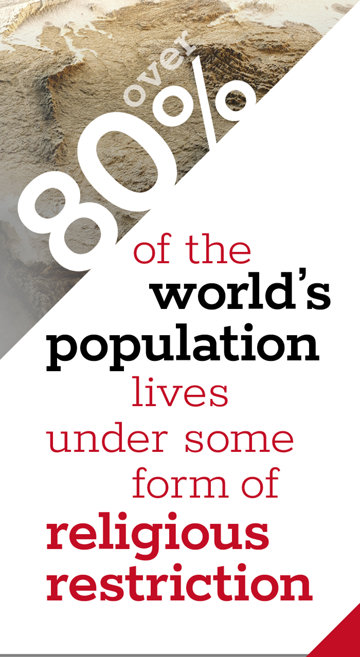
Dr. Lantos Swett placed those examples in statistical context. More than 80 percent of the world’s population lives under some degree of religious restriction, she noted, even as more governments appoint envoys dedicated to protecting freedom of religion or belief.
“Robust religious liberty can change a country.”
Panels throughout the summit examined developments in China, Iran, Russia, Nigeria and parts of South Asia. Discussions addressed diplomatic pressure campaigns, coordinated advocacy strategies and the responsible use of artificial intelligence to document abuses and verify testimony. Transnational repression emerged as a recurring theme, with speakers detailing how authoritarian governments use a range of tactics to target critics beyond their borders—including members of diaspora communities, activists, journalists and even foreign nationals—through surveillance, harassment, intimidation and threats to relatives abroad.
A panel featuring US Ambassador to the United Nations Mike Waltz explored the security implications of such tactics, emphasizing the need for democratic governments to coordinate responses when intimidation crosses borders.
The summit also moved beyond analysis to individual cases. Organizers announced the adoption of specific prisoners of conscience—including Chinese pastor Ezra Jin and Uzbek Shia Muslim Fayzulla Agzamov—as focal points for sustained, multi-organization advocacy campaigns. By concentrating attention on specific detainees, participants sought to convert visibility into diplomatic pressure.
The human dimension of those cases was underscored by Grace Jin Drexel, Pastor Jin’s daughter, who addressed the summit about her father’s detention and deteriorating health. Her remarks shifted the conversation from policy frameworks to personal consequence.
Advocacy also extended to Capitol Hill. Participants spent a week meeting with members of Congress before the summit and later convened a well-attended Congressional Advocacy Day, underscoring a sustained and robust push for legislative and diplomatic action to protect freedom of religion or belief.
Throughout the program, speakers emphasized that democracies carry particular responsibility in setting standards. As Wake Forest University School of Divinity professor Melissa Rogers, a former White House faith-based office leader, succinctly put it: “It is important for democracies to lead by example.”
Legal advocates linked that principle to international credibility. “Robust religious liberty can change a country,” Jordan Sekulow, executive director of the American Center for Law and Justice, told attendees. “It can change how it is viewed around the world.” He argued that a nation’s treatment of its faith communities increasingly shapes diplomatic trust and global standing.
The summit functioned less as a platform for broad declarations than as a coordination hub—aligning data collection, case advocacy, legislative outreach and diplomatic engagement. Organizers described plans for follow-up campaigns, continued coalition-building and expanded international partnerships in the months ahead.
In that sense, the 2026 International Religious Freedom Summit offered more than a diagnosis of global trends. It presented a model of collective response—one rooted in the conviction that defending freedom of belief safeguards the rights and agency of the individual and contributes to stability in an unsettled world. Whether that model can change conditions on the ground will ultimately be measured in the freedoms enjoyed by, or denied to, those it seeks to protect.
As Thomas Jefferson famously said: “The constitutional freedom of religion [is] the most inalienable and sacred of all human rights.”