

All too often, the media either ignores religion, denigrates it, covers only the scandalous and controversial aspects of it, or reports religious issues with a stunning lack of knowledge about what it’s like to live a life of faith.
Knowing that sensationalism sells, journalists often consider ordinary faith-based articles boring when compared to, let’s say, columns about sex abuse or acts of violence by religious extremists.
So that’s what journalists write. The steamier, the better.
“Despite overwhelming evidence that religion, spirituality, ethics and morals are inherent in all aspects of human life, news producers fail to recognize this fact.”
“It is a given that the national press focuses on the most sensational stories, which typically are not flattering to our faith,” Dwayne Hastings, editor of Faith & Family Magazine, said.
But in truth, religious events are often far from steamy. They’re actions of congregations helping strangers in times of disaster, or tithing to raise money to aid the poor, or quietly beseeching their God to guide humanity in the right direction.
Not exactly clickbait, huh?
A study from the International Association of Religion Journalists (IARJ) found that “religion coverage is often inconsistent, risk-averse and increasingly pushed to the margins of mainstream news.”
The study, produced with the Faith & Media Initiative (FMI), comes from a survey of 9,489 people in 18 countries and over 30 in-depth interviews with journalists and editors.
It reads: “There is universal agreement among journalists that coverage about faith and religion has become more marginalized due to a set of newsroom dynamics.”
Economics is chief among them, as tight budgets have led to fewer journalists being assigned to the religion beat. As a result, only a few dozen full-time reporters now specialize in religion, down from about 100 in the 1990s. General assignment reporters, often unfamiliar with the subtleties of religious issues, now catch many of those assignments, and sometimes muck them up.
Compounding the problem is a widespread misconception among editors that religious stories are a “turnoff” and won’t attract audiences.
“Despite overwhelming evidence that religion, spirituality, ethics and morals are inherent in all aspects of human life, news producers fail to recognize this fact,” the study states.
“Even when the amount of religion news increases, the media’s tone remains cold, questioning, even hostile,” Tim Graham, Media Research Center (MRC) director of media analysis, remarked.
“The more traditional or orthodox the religious belief, and the more influential it threatens to become in the culture at large, the more the television networks seem to explain it away, as something ‘scholars’ and ‘experts’ dismiss.”
But a 2022 study by Global Faith and News (GFN) found that 63 percent of people say high-quality religious coverage is needed, and 56 percent say they would be more likely to engage with any publication that delivers it.
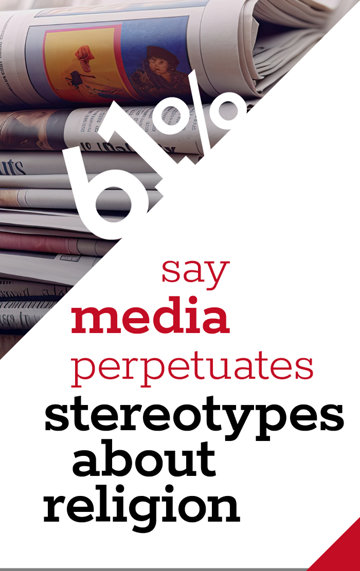
It also found that 53 percent believe the media ignores faith, and 61 percent charge that the media perpetuates stereotypes about religion.
Darren Hewer, author of an online faith blog, wrote that, “Christians are weirdos. At least, if you read the daily news, that’s likely the message you’ll get.”
“The real culprit in coverage problems of religion news is … ignorance from reporters unaware of the complex diversity of religious belief,” said Debra Mason of the Religion Newswriters Association.
But even mainstream religions get misrepresented and misunderstood. The New York Times once wrote, for example, of “the vast Church of the Holy Sepulcher marking the site where many Christians believe that Jesus is buried.”
Of course, Christians don’t believe that at all. They believe Christ rose from the dead—and is therefore “buried” nowhere.
A religion reporter would have spotted that mistake a mile away.
The problem is likely not so much a sinister effort by secular journalists to paint religion in a negative light as it is a pure and inevitable consequence of ignorance and incompetence when it comes to religious subjects.
“The real stories are Christians serving quietly and changing lives in Christ’s name,” said Hastings. “While reporters look for the chinks in Christians’ armor, we need to be diligent telling the story of what Christ did for mankind by every means God provides.”
Journalists need to develop what Axios founder Mike Allen termed “faith fluency,” an understanding of religions, their practices and their members—from Christianity to Scientology—before they can even attempt to cover religious events and communities with any semblance of competency.
Or, to put it more bluntly, members of the media need to climb down off their high horses, learn about their subjects and do their jobs.
People of faith aren’t strange or unusual. They are among the very best of us.
It’s time for the media to tell their stories, too.
Otherwise, they simply aren’t telling the truth.