

“Any person making a request for information to a public authority is entitled—(a) to be informed in writing by the public authority whether it holds information of the description specified in the request, and (b) if that is the case, to have that information communicated to him.” —Section 1(1) UK Freedom of Information Act 2000
“… a public authority must comply with section 1(1) promptly and in any event not later than the twentieth working day following receipt.” —Section 10(1) UK Freedom of Information Act 2000
Those public authorities expected to be working for—and answerable to—the people include police forces, state schools, local councils and health departments, as well as certain private companies that provide health services under government contracts.
All are bound by the same law. All are required to respond. Too many simply don’t.
These grim figures are symptoms of institutions that have grown comfortable ignoring their legal obligations.
When public bodies ignore lawful requests, it is not just paperwork that stalls. Journalists are blocked. Citizens are left in the dark. Families wait for answers. Accountability crumbles.
In early December, the Information Commissioner’s Office (ICO)—the watchdog charged with enforcing the Freedom of Information Act—reported what requesters across the country had already experienced firsthand: “significant failures” in FOIA compliance across multiple public bodies.
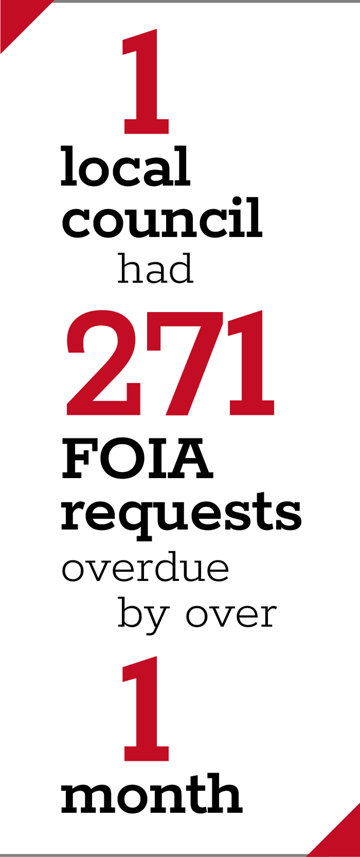
The situation is as serious as it is widespread. One London borough council had 271 open FOIA requests, all of which were more than a month overdue, with the ICO noting that additional requests may not even have been logged yet. A major healthcare organization in Cambridge had more than 200 open requests—nearly a third of which were over a year old—and its recent compliance rates have languished between 14 and 50 percent. A Northern Ireland ambulance service managed a timely response rate in just 34 percent of cases.
These grim figures are symptoms of institutions that have grown comfortable ignoring their legal obligations.
Faced with this pattern, the ICO initiated “interventions” with the relevant public authorities. Those that demonstrated genuine, good-faith efforts to comply but lacked the capacity or systems to do so were issued Practice Recommendations, offering guidance on improving internal processes and clearing backlogs.
But authorities found to be routinely withholding information or failing to respond at all were served Enforcement Notices—a far more serious measure.
As the ICO itself explains, “the consequence of failing to comply with an Enforcement Notice is that the Commissioner may make written certification of this fact to the High Court.… Upon consideration and inquiry by the High Court, the Trust may be dealt with as if it had committed a contempt of court.”
Silence, in this case, is not golden—it’s suicide. Phillip Angell, ICO’s Head of FOI and Transparency, put it this way: “Those making FOI requests should do so knowing that they will receive a response in a timely manner with adequate advice on any next steps that can be taken. And those failing to meet their basic duties should and will be held accountable.
“The recent action taken against these public authorities demonstrates our firm approach to FOI and accountability, particularly in tackling systemic transparency issues.”
Both the softer Practice Recommendations and the sharper Enforcement Notices typically require the same ultimate remedy from the offenders: an action plan that ensures the gears are well greased for high levels of compliance in the future. The requirement may also include a “lessons learned” exercise examining the root causes of their delays, mishandling and withholding of information.
The Freedom of Information Act was never meant to depend on the recipient’s generosity in offering requested data. It was designed to compel openness, even when staying mum would be less embarrassing.
The ICO has now made it clear that undue silence in response to lawful requests will no longer be tolerated.
Whether public authorities finally find their voices—or face the courts for refusing to speak—will determine if transparency in the UK remains a legal right or becomes an empty promise.