

The Sutherland Institute, a Utah-based public policy think tank, has released a one-of-a-kind report analyzing the views of religiously unaffiliated Americans—commonly known as “nones”—on the value of religion in society.
The survey of 1,106 US adults, including 395 nones, found that 77 percent of nones viewed religion as “part of the problem,” with 32 percent saying this was “definitely” the case.
With nones now comprising over a quarter of the US population, that “77 percent” means that nearly one in four Americans harbors a negative attitude toward religion.
“When presented with facts over ideology, service over sermons, and principles over institutional prerogatives, even skeptics can recognize religion’s contributions.”
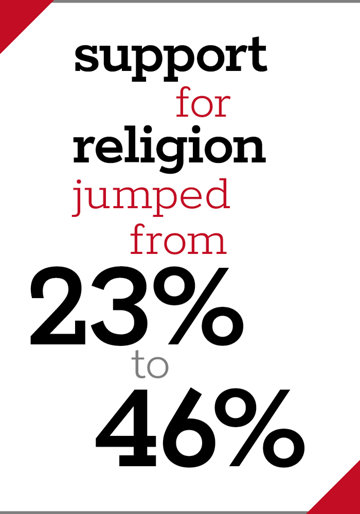
But here’s where the survey moved from documentation to intervention: Once given the facts about religion’s societal contributions—such as the fact that 75 percent of disaster relief organizations working with FEMA are religious, or that religion contributes $1.2 trillion annually to America’s economy—the proportion of nones seeing religion as part of the solution doubled from 23 percent to 46 percent. Even atheists and agnostics experienced a 21 percent change of heart toward the subject of religion when briefed on its real-world contributions.
“The results of the Sutherland Institute/Heart+Mind survey suggest that telling the story of religion’s value to society, grounded in the facts, can noticeably improve opinions about religion,” said Bill Duncan, a religious freedom scholar at Sutherland.
The survey carries a profound message: that the religious-secular wall that divides us is neither fundamental nor permanent—and stems not from hostility but lack of awareness.
As the report states: “When presented with facts over ideology, service over sermons, and principles over institutional prerogatives, even skeptics can recognize religion’s contributions, and even believers can acknowledge secular concerns.”
And if over 60 percent of nones can acknowledge the societal benefits faith-based groups bring, collaboration between secular and religious communities becomes possible. The findings take on added significance when paired with the national landscape: American nones presently outnumber Catholics or evangelical Protestants. And while 56 percent report being satisfied with their lives, 32 percent of nones acknowledge that there is still “something important missing.”
That missing something is community—what political scientist Robert Putnam describes as “social connectivity.” “Regular church attendees reported talking with 40 percent more people in the course of the day,” Putnam writes.
And per the report, “it is exactly this social connectivity that religious communities foster” which nones report they are “missing.”
Scientology Founder L. Ron Hubbard highlighted this phenomenon in his celebrated essay, “Religious Influence in Society.” He wrote: “Religion is the first sense of community. Your sense of community occurs by reason of mutual experience with others. Where the religious sense of community and with it real trust and integrity can be destroyed then that society is like a sand castle unable to defend itself against the inexorable sea.”
He continued: “For the last hundred years or so religion has been beset with a relentless attack. You have been told it’s the ‘opiate of the masses,’ that it’s unscientific, that it is primitive; in short, that it is a delusion.
“But beneath all these attacks on organized religion there was a more fundamental target: the spirituality of man, your own basic spiritual nature, self-respect and peace of mind. This black propaganda may have been so successful that maybe you no longer believe you have a spiritual nature but I assure you you do.
“In fact, you don’t have a soul, you are your own soul. In other words, you are not this book, your social security card, your body or your mind. You are you.
“Convince a man that he is an animal, that his own dignity and self-respect are delusions, that there is no ‘beyond’ to aspire to, no higher potential self to achieve, and you have a slave. Let a man know he is himself, a spiritual being, that he is capable of the power of choice and has the right to aspire to greater wisdom and you have started him up a higher road.”