

At times, they are intertwined—woven together as part of Christian faith. At other times, society and its many diverse believers see a different “reason for the season,” dismissing its holy side with a cheerful “Happy Holidays” instead of “Merry Christmas”—a phrase that, after all, comes from “Christ’s Mass,” the joyous Christian celebration of the birth of the Son of God, with us, here on Earth.
Believers or not, they insist on savoring the joy and sharing the season.
Those of us who are Christian believers, like me, go off to church to uplift our spirits in prayer, to light candles and sing “Joy to the world, the Lord is come.” We kneel before a manger in a crèche witnessing a tiny glowing baby, with a shining star of the east overhead and three Wise Men who come bearing gifts, a little drummer boy, who is found nowhere in the Bible but is there anyway (see how things become mixed up together?) and a host of farm animals, all, like us, kneeling in adoration.
Then we return to our homes, where we drape pretty little colored lights and gleaming ornaments outdoors and inside, on trees we have brought into our homes for just this season.
Drive through neighborhoods at night and everything takes on a bright, colorful aura of happiness and twinkling, and you know, for sure, that something very special is going on, no matter the beliefs of the people inside.
Believers or not, they insist on savoring the joy and sharing the season.
Bless them for it.
We spend the rest of the holy day nestled against winter’s chill in the warmth of a loving family amid piles of crumpled, gaily decorated wrapping and new toys. We drink eggnog and kiss under the mistletoe.
That’s where the “heart” part comes in.
As for the “imagination,” in a Christmas cartoon fantasy, we tell our children harmless fibs about jolly old Santa Claus and his elves and reindeer pulling a magical flying sleigh. We leave out dishes of cookies and glasses of milk for Santa when he arrives, ensuring they are partly eaten and sipped before the kids wake up.
The kids soon see through our make-believe, but pretend they still believe, eventually passing on the Santa mythology to their own children each year.
All of it together—spirit, heart and imagination—is what we call Christmas.
But where did all these customs come from?
To understand, we need to look back over two millennia of history.
The Date: December 25
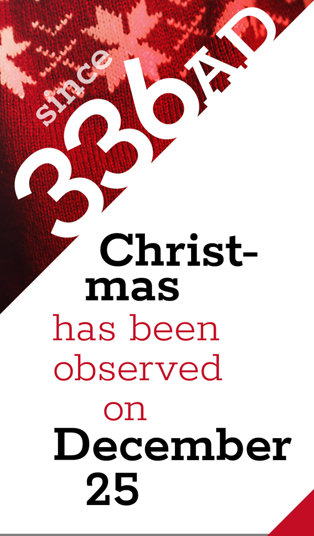
The story goes back to Roman days, and the work of Christian historian Sextus Julius Africanus, who picked December 25 as the birthday of Jesus. That date was already a Roman holiday, honoring the winter solstice. And though there’s no evidence for it in the Bible, the celebration has continued since 336 AD.
The Tree: Evergreen Roots and Candlelight
But what about the tree? After all, there are 25 to 30 million Christmas trees sold each year in the US. There must be a reason behind it.
Like many Christmas traditions, the tree also came from pagan roots, with northern European pagans bringing evergreen boughs indoors in longing anticipation of spring.
The tradition of putting lights on those trees is attributed to Protestant Reformation leader Martin Luther in the 1500s. He wanted to bring the sparkle of stars into his home and attached lit candles to a tree.
It didn’t take long in Germany for decorations like bows, apples, cookies and garland strings of popcorn and nuts to be replaced with mass-produced tinsel and safer electric lights.
Mistletoe and Holly
Kissing under the mistletoe was likely inspired by Druid and Norse beliefs, since mistletoe, an evergreen, represented vivacity and love to them, and Frigg, the Norse goddess of love, vowed to kiss those who passed beneath it.
The prickly leaves of the holly symbolize, for Christians, the crown of thorns Jesus was forced to wear at his crucifixion.
Santa Claus: From St. Nicholas to Jolly Old Elf
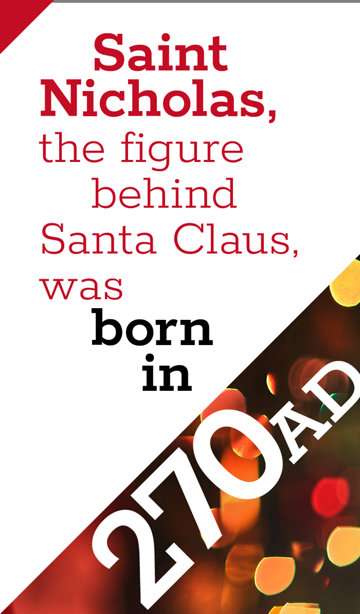
As for Santa Claus himself, he arises from St. Nicholas, born in the third century AD.
In the Middle Ages, the Dutch celebrated him as Sinterklaas. His legendary habit of secret gift-giving inspired a tradition of placing money in the shoes of the poor and evolved into placing gifts in children’s shoes.
The precious fantasy of the sleigh and Dasher, Prancer, Vixen and the whole reindeer gang comes from Clement Clarke Moore’s beloved 1823 poem, “A Visit from Saint Nicholas.”
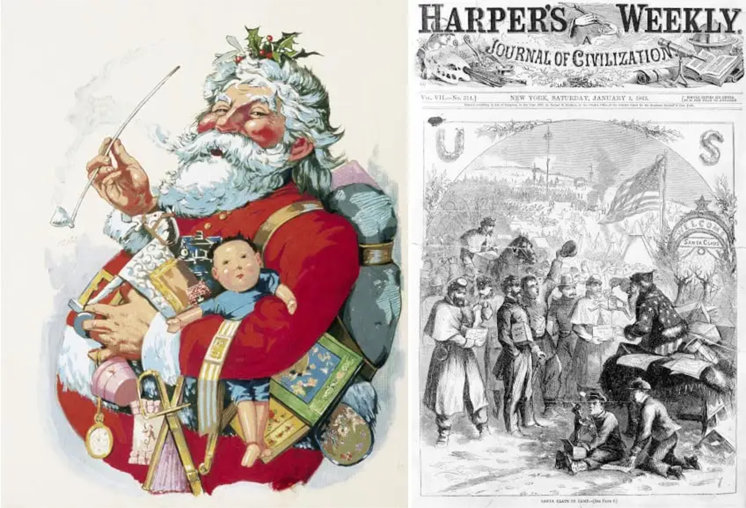
And we get our vision of jolly Santa—big belly, white beard, red suit and all—from cartoons drawn by Thomas Nast later that century.
Songs, Drinks and Gifts: Tradition Across Time
Favorite Christmas tune “Jingle Bells” was written by James Lord Pierpont in 1850, but was originally called “The One Horse Open Sleigh.” According to one version, he scribbled it down while nursing a drink in the Simpson Tavern in Medford, Massachusetts. More likely, he wrote the song in a Boston rooming house.

Our favorite drink, hands down, for Yuletide—“Yule” being the name of an old Norse seasonal celebration—is eggnog, a sweet (and often powerful) mixture of eggs, milk, sugar and a healthy slug of rum, brandy or whiskey, likely named after the wooden “noggins” in which the beverage was served in rowdy pubs.
Gift-giving, an ancient tradition, became part of the celebration of Christmas as a nod to the Biblical tale of the three Wise Men bringing gold, frankincense and myrrh gifts to the baby Jesus.
From these origins to the present, Christmas has grown and transformed across centuries and continents, evolving into a holiday whose reach today is truly staggering.
Ninety percent of Americans, no matter their religious beliefs, plan to celebrate Christmas and 80 percent have their own tree.
That’s about as overwhelming a majority as you can get.
Christmas, of course, began long, long ago, before any of us were born, and it will still be around, long, long after we have passed away.
It is a lasting part of our spirits, our hearts and our collective imaginations.
In short, Christmas is us.
And it’s wonderful.